

One of the most epic single-day pushes I’ve ever experienced in the mountains was the Ptarmigan Traverse. In 2023, my buddy Jacob and I had big dreams. We had seen Kaytlyn and Jenny’s North Cascades High Route adventure and were inspired to travel to the North Cascades and make some memories of our own. We loaded a car full of mountaineering gear and snacks, and 12 hours later we were in Washington.
We were realistic and reasonable. The full High Route was insane, we weren’t ready for that. But break that route into its five component traverses and knock out two or three of them over a week? Maybe tack on a volcano summit? That was doable. We’d start with Ptarmigan, the section we were most excited about. Fast and light was the name of the game. The FKT was around 9-10 hours, but we’d be taking it easy, so we figured 14-15 hours, maybe up to 18 worst case. Turns out, worst case was spot on.
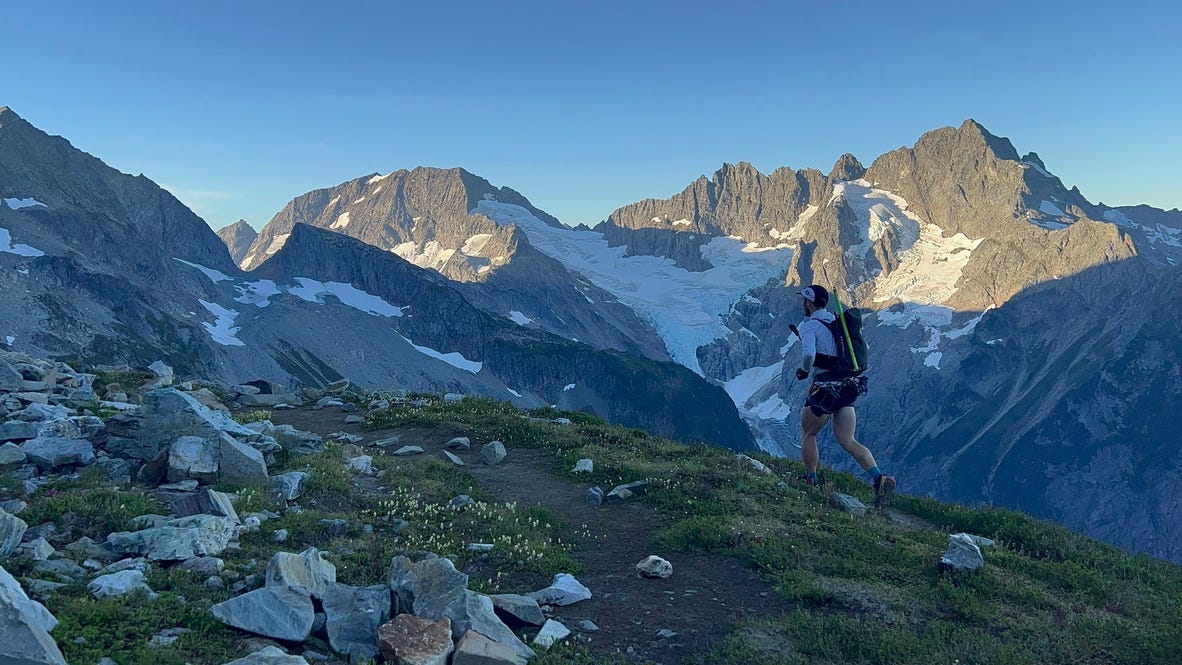
By the time the morning sunlight hit us, we had already crossed the first glacier of the day. Everything was going perfectly. It was more beautiful than I’d imagined. I really cannot overemphasize how stunning most (but definitely not all) of this route is. Maybe it’s my Washington bias but the North Cascades are very hard to beat. In contrast with the easily accessible, relatively tame Wasatch, they feel wild and remote, endless and massive.
Most people do the Ptarmigan as a multi-day backpacking trip. To have any chance at our proposed agenda, we needed to take a fast-and-light approach. Speed is safety when traveling with limited warm layers, food supplies, backup batteries for headlamps, etc. Each item in our packs was carefully considered and its necessity debated before it earned its place. Though we needed to move quickly, we also valued our lives and did not want to end up in the bottom of a crevasse. Therefore, a rope, harness, ice axe, and traction all made the final cut. The terrain posed objective hazards with certain unavoidable risks, but through careful decision making we aimed to minimize those risks (and avoid the more controllable ones) while accomplishing our goal as quickly as we enjoyably could.
That day on the Ptarmigan Traverse taught me something that applies to training. Building fitness also involves hazards that are within the control of the athlete. One risk that’s been in the back of my mind since my first tibial stress fracture in high school is overuse injuries. Athletes pushing themselves in training are periodically riding a thin line between maximizing their potential improvements and overdoing it. We have coaches who help guide us and we make plans that we think should be safe, but you only have to slightly overdo it to set you back a lot more than any potential gains you’d miss out on by slightly under-doing it. I’ll come back to this, but first I’m sure you’re dying to know more about how the Ptarmigan day went.
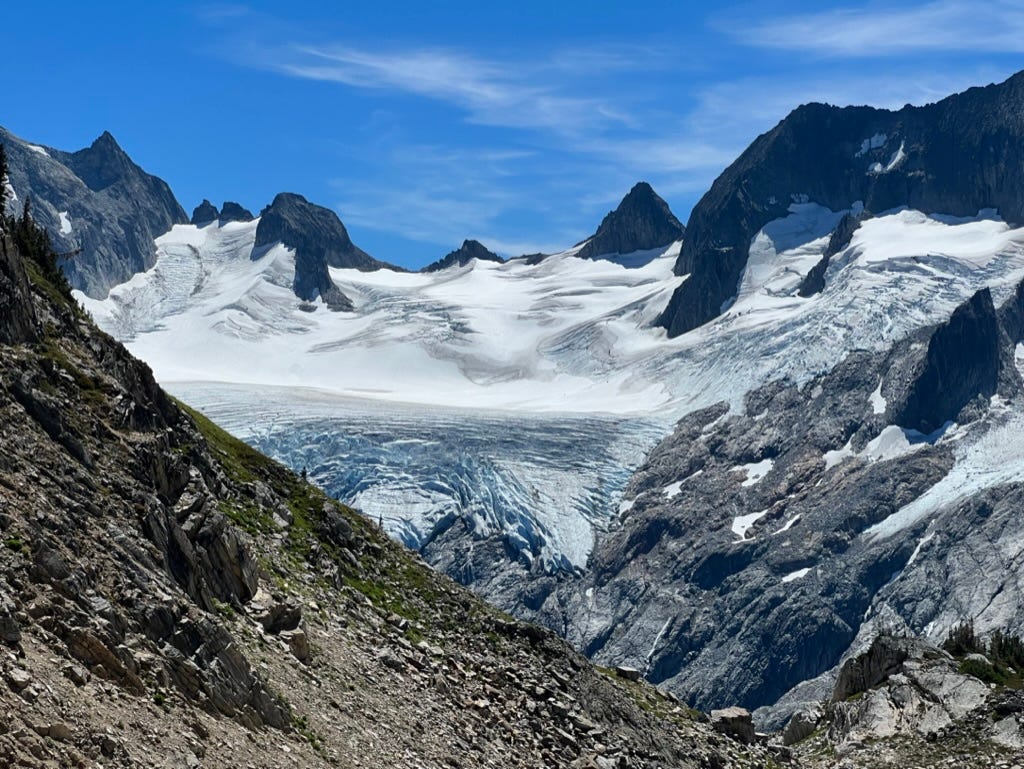
As it turns out, Jacob and I weren’t the well-oiled mountaineering machine we dreamed we might be. Donning harnesses and crampons, tying into the rope, and weaving through a maze of crevasses on glacier after glacier took a toll on us. At the crest of each mountain pass I was briefly relieved, knowing we were one valley closer to our finish. Until I traced the route with my eyes looking at the looming glacier on the wall of the next valley, knowing that we not only had to climb it, but also had to cross the miles of loose rock, bush, and ponds just to get to the base. We lost time on transitions. Our socks and shoes soaked through and after some hours we got severe cases of what we in the biz (me and Jacob) like to call bathtub feet. At first it seemed like a minor inconvenience. The increasing pain of wet bathtub feet drained our morale, our hungry bellies drained our food reserves, we were desensitized to the alpine beauty, but we continued pressing forward, still making decent progress. But my heart sank when we finally began our last descent and I saw…
You gotta love a good cliffhanger. The tough thing about overuse injuries is that they’re so preventable. All you have to do is not destroy yourself too much in workouts and long runs. Get decent sleep. Eat enough. Rest when you feel pretty tired. It’s not that hard. But as we traverse the constant passes and valleys of training, we sometimes neglect our bathtub feet. They don’t hurt at first, they’re just wet. It’s not really a big deal. Then they get slightly annoying, but they’re not really causing problems so we press on. Then, “all of a sudden”, they cause crippling pain and force a stop.
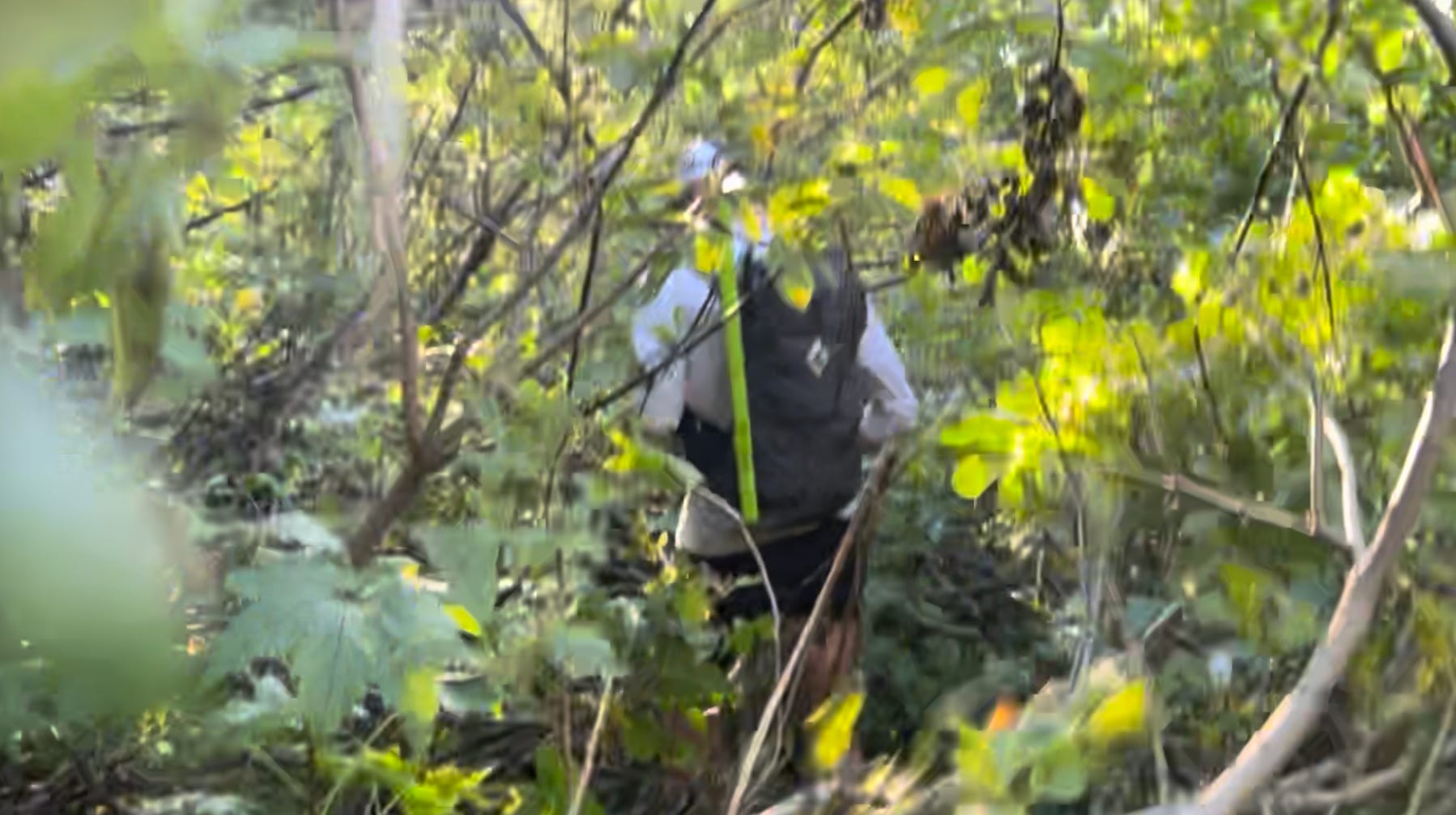
…thorny devil’s club as far as the eye could see. We had read about the terrors of this exit, and knew there would likely be some bushwhacking. We mustered our strength for one ultimate push. Our blistered, trench-footed stomps flattened the prickly foes and we battled like heroes for our freedom. Those bushes never stood a chance. We emerged near Downey Creek at the bottom of the valley and celebrated by consuming the last of our food, just as night was falling. I figured we’d be within a mile or two of easy jogging to the car, where more snacks and cold drinks awaited us.
Overuse injuries are frustrating. An athlete in tune with their body knows that something is up. It’s a sneaking suspicion that manifests itself in a slight twinge, a gut feeling that you should be eating more, or a temporary decrease in motivation. But we’re trained to push through discomfort, that’s how we progress. You don’t make it through the bush without getting some scrapes. Any good workout should have you pushing through a little discomfort by the end. Knowing when that’s a good thing vs when it’s detrimental is something we learn through experience, and sometimes have to relearn.
We spent the next three hours searching for what I’ve been told was once a trail. As of 2023, it was a dotted line on the map that looked like a decade of deadfall had descended upon it. Dense bushes, of both thorny and non-thorny varieties, had crept in due to lack of traffic and maintenance, invading the spaces between fallen trees and ensuring that those final dark miles took us as long as possible. There was also the matter of miscalculating distance. In my pre-Ptarmigan mind, we probably had a couple miles left. In reality, it was likely about 5 miles. But in the moment, it was endless limping on the sensitive soles of our wrinkled bathtub feet.
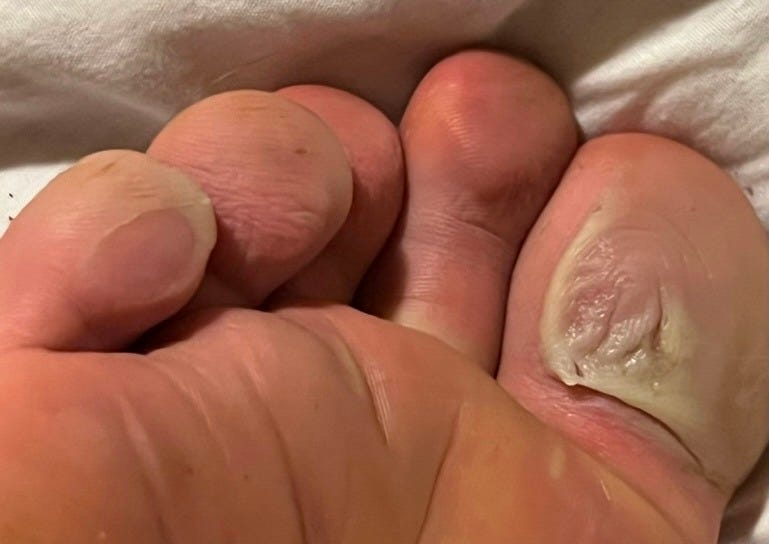
Jacob tried every coping mechanism in the book to endure the suffering, from playing Linkin Park on his phone speaker to crying many tears (sorry Jacob). Having a friend alongside me who was in a worse mental place than me actually helped get me through, because compared to him I was still doing alright. He also did a good job documenting the day on his Youtube channel if you want to go deeper down the Ptarmigan rabbithole.
Usually when I look back on mountain adventures or ultramarathons, the passage of time between now and when the suffering occurred tends to erase most of the pain and just leave behind the epic views or the alpine excitement in my memory. Ptarmigan Traverse stands out because the suffering of that exit is just as memorable as the awesomeness of the glaciers, if not more.
Recovery from injury takes time. While the exact amount of time can vary greatly, it is often the case that upon diagnosis I set expectations for the early side of the time range it would take “normal people.” 3-6 weeks? Ok, I can be good to go in 2-3. When that time arrives and I’m not finished healing yet, I’m disappointed. I know I do this but I can’t help myself. It feels endless, constantly thinking the end might be just around the next corner but only finding more obstacles to slowly pick my way through. Eventually it has to end, but why can’t we just hurry up and get there already?
It helps to have people to share the experience with. Other friends who are recovering from other things and are down to exercise in other ways. Biking, skiing, low-impact activities. By the time we’re on to the next adventure, maybe some of the pain and annoyance of the injury will be erased. Hopefully, just enough of that memory sticks around that we don’t have to relearn the lesson of overdoing it again any time soon.

The North Cascades are so incredible. I tried to explain Devils Club to a Coloradan and couldn’t do it justice. I just finally said you’ll know it when you see it and it will suck. Great effort!
The Suiattle River Road that the exit trail goes to got badly washed out in storms this winter, the road will probably be closed for a couple years or more. It means the full traverse is infeasible for awhile, but it might more enjoyable (albeit far less aesthetic) as an out-and-back anyways.