

You’re at the front of the race you’ve been daydreaming about for years. Hitting potentially record-breaking splits. Blazing through the furnace that is the Canyons, charging across the Rucky Chucky river crossing, surrounded by encouraging spectators and cameras and friends. Then you get to the far shore, with a steep climb up a dirt road to Green Gate. The sounds of cheers and the rushing river fade into the background. You put your head down, drop into your lowest gear, and grind up the hill. That’s when it starts to hit you that you still are 22 miles from the finish line. The job is nowhere near done. And everything hurts.
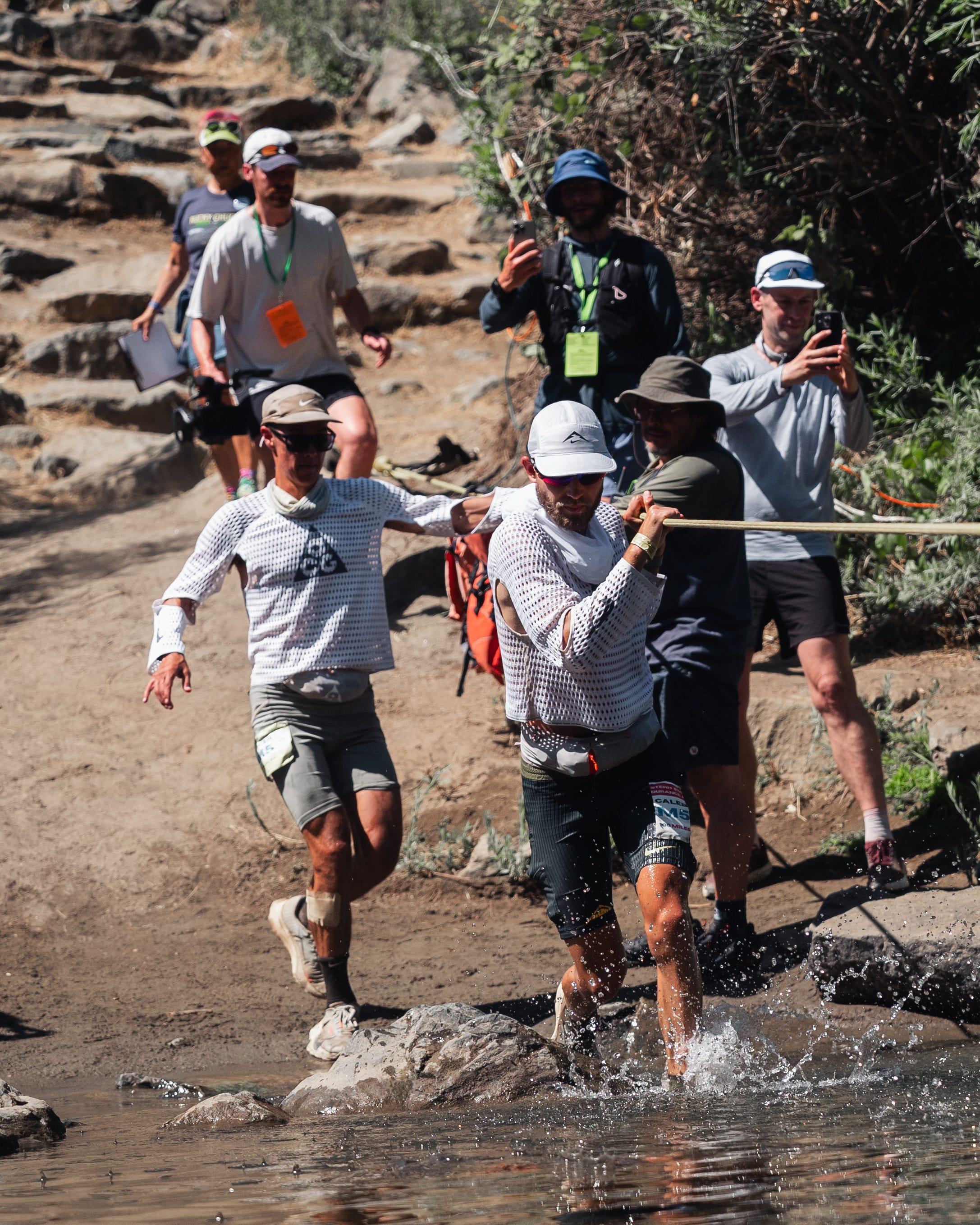
Before Western States last year, I’d always imagined that the energy of leading a big race would give me some superpower of extra motivation. Instead, it filled me with fear. I wasn’t hunting, I was being hunted, and it took all of my focus to keep the crushing weight of my own expectations from slowing me to a walk. When I was feeling good earlier it was easy to let visions of sprinting across the finish line for the win fill my mind. Now, Chris and Kilian were closing on me. The splits were getting smaller. I knew I was slowing down. It got so bad that shortly after Green Gate, with 80 of the 100 miles already completed, I was in a mental battle of trying to convince myself I still cared. That this was worth it. I wasn’t having fun, I was falling off the goal finish time I’d been trying to hit, I was going to get passed and all that hard work was going to be for nothing. All that pain just to end up right around where I’d finished the previous year.
Looking back now at last year, I can see that what it took for me to win that day was outside help. My crew and pacers. I wasn’t significantly fitter than Chris or Kilian or probably many of the other guys out there. A few minutes difference over 100 miles doesn’t come down to training philosophy or time in the gym or raw speed. It’s a mental game, and my crew was there to help me get my mind right when I thought things were falling apart. I’m excited to watch this year’s race closely to see what strategies others take when the going gets tough.
I approached Western States with the attitude of wanting to dig deeper into myself than I ever had before. I knew that would hurt, and I was dreading it, but also curious and excited to see what I’d find down there. I thought I was ready to smear myself into the dirt just to see what happened. That mindset allowed me the confidence to take the race out hot and hang on until I was able to pick up my first pacer, my buddy Anthony, at Foresthill. Once I had someone running alongside me, there to support me and keep me accountable, I felt like I could turn my brain off a bit and rely on someone else to keep me moving. Anthony was exactly who I needed to help me transport through the hottest part of the course in what I now remember only as a blur.
But after that river crossing when things got a little darker in my head, I picked up my next pacer, my long-time adventure partner, Jacob. We’ve seen each other at low points before and he was experienced at knowing what to say (and more importantly, what not to say), to keep me going. He reminded me of why I was out there, how far I’d come, how I’d feel after if I could just hold on a little longer. He was also quiet when he could tell I didn’t want to form sentences. I stared at his feet and put my own where his had been, trying to match every move in perfect rhythm, trusting that it would get me where I needed to go.
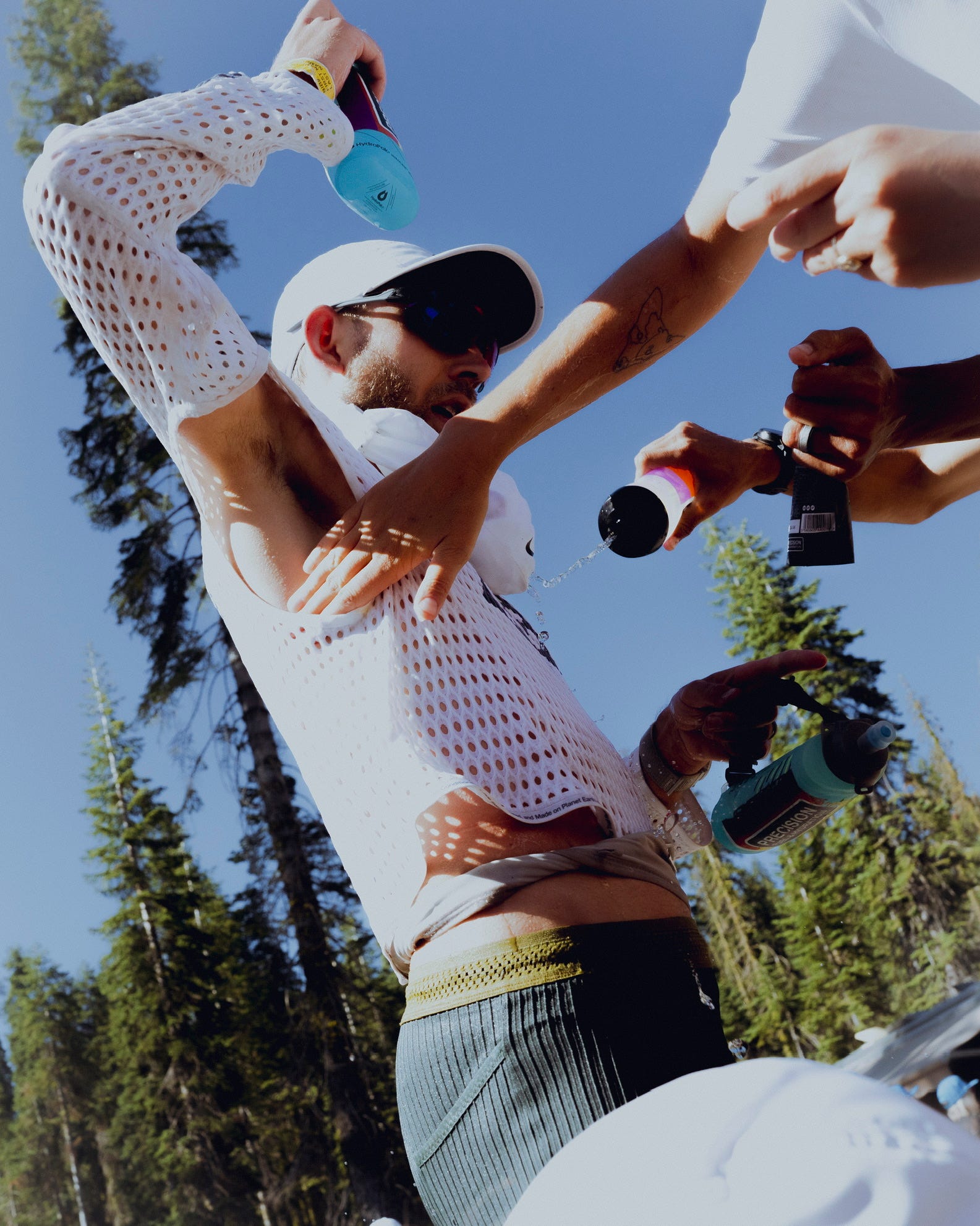
Along the entire journey, every couple hours or so, I’d get a huge boost. I would arrive at a crewed aid station, where family and friends executed rehearsed pit stops flawlessly. Cooling ice bandanas and water were expertly applied, while bottles of electrolytes were swapped out with fresh, marvelously cold ones. Chris Harris, aka Minty, has worked with me as my dedicated race nutritionist for years now. He’d collect used bottles and gel wrappers, weigh them, calculate my intake, compare it against my estimated needs and my original plan, and make adjustments as needed. Having Minty’s professional guidance gave me one less thing to worry about because I trusted that if I could just take in as much as possible of the fuel and liquids I’d received, I’d be alright. The whole aid station process took mere seconds and then I was on my way again, leaving with a fresh coat of sunscreen, pockets full of gels, brain full of images of smiling faces I wanted to run fast for. Every once in a while I’d even get to see my wife, Morgan, holding our newborn son out there (or a huge sign of his face).
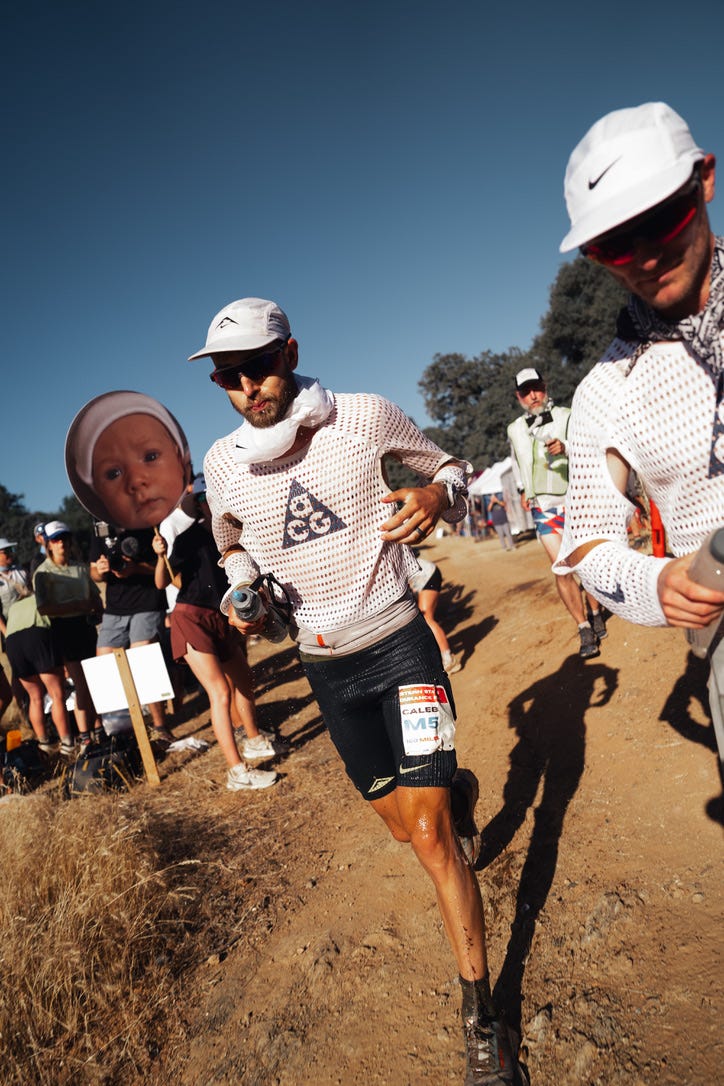
Having baby Marshall join the family changed my perspective on running a bit. I’ve often struggled to justify the time I spend running because it feels like this selfish thing that I just do because I enjoy it, often at the inconvenience of my wife and others who I then don’t spend that time with. Even though they’re very supportive, there had still been some feelings of guilt there. Marshall made me want, more than ever, to run for more than myself. I wanted to prove to him that I could do really hard things. I wanted to get to each next crew point where I knew I’d have a possibility of seeing him. I wanted to cross the finish line as quickly as possible because I knew he’d be waiting. And I wanted to set myself up for a success in the sport because I want him to see that pursing what you love can be a legitimate career path.
If I could give one other bit of advice on how to mentally prepare for a big goal race, what I’ve found works best for me is to take my taper seriously. And by that, I mean relax. Put in all the good training you need ahead of time, and when you get within about two weeks of your important event, don’t do anything that taxes yourself mentally. No pain, no hard workouts. The fitness is there, the freshness will do you more good than another workout possibly could. Try to take as much work and family stress off yourself as you can by frontloading anything that needs to be done so that race week can be chill. By the time the race rolls around, your legs will feel more energized than they have in months. Your mind will be craving a long, hard adventure and the race is the reward.
After racing Western States the past two years and having amazing experiences out there both times, I’m really looking forward to participating in the race again this year in a non-competitive capacity. After kicking off my time in Tahoe with the Broken Arrow Ascent and hanging around for TrailCon and training all week, I’ll be turning last year’s tables and pacing my ACG and Precision F&H teammate Anthony Costales for the same section where he paced me. It’s a little bittersweet being in this environment with the race approaching this weekend and knowing I won’t be in a position to defend last year’s win. Even if that had been my plan, after dealing with an early-season injury I’m not anywhere near the shape I was in this time last year and things wouldn’t have gone well. But it’s hard not to compare and reflect back on the life-changing event that was WSER 2025.
If you feel like going deeper down the “Western States from the mind of Caleb” rabbit hole, check out my detailed race recap from last year and an article I wrote about the many Other Things that go into success at this race.

Thank you for sharing this, Caleb. A beautiful reminder that the strongest legs are carried by humble hearts, trusted hands, and the people who believe in us when we struggle to believe in ourselves. Our greatest victories are never ours alone.
Great read, especially after listening to the freetrail champions panel interview